My oldest hobby: Amateur Radio
My call sign: WC5WC (old call WN5GQH and WA5OTR)
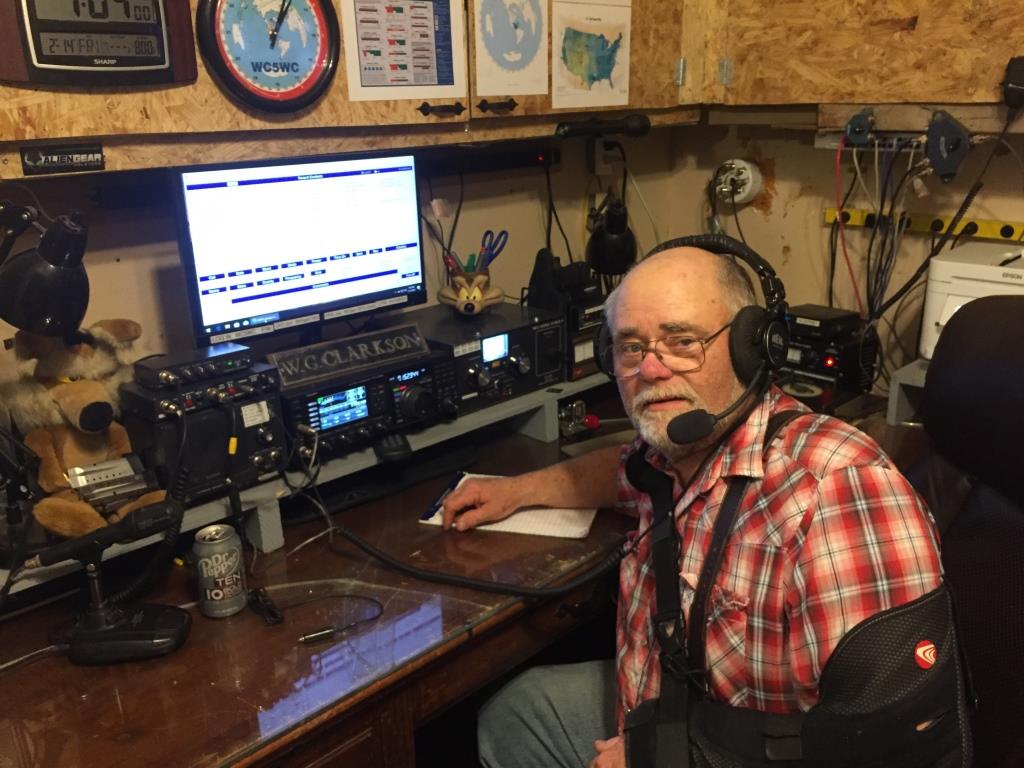
This section of my web site is about a really great hobby that not only has supplied millions of people of all ages a really great way to use their spare time in constructive ways, it has also inspired many young men and women to seek careers in the field of electronics and historically been the source of many advances in the field of communications electronics.
If you enjoy communicating with other people on the Internet, you will probably enjoy this hobby also. It provides the participant with communications with other people, not only locally, but internationally. It also provides a tremendous amount of public service by providing volunteer backup communications in emergencies to governmental organizations in disaster hit areas. Probably the most visible means of volunteer activity is the large number of mobile Amateur Operators who have attended severe weather spotter training and who voluntarily go out into severe storm areas to track severe weather for the National Weather Service, and County and City Civil Defense Organizations. The single most important means of tracking and identifying severe weather as it happens is by the use of eyes in the field. Radar can only show so much. It cannot show what is actually happening on the ground in a severe weather situation. Only trained eyes watching these storms can supply this information so that the Weather Service and Civil Defense Authorities can make informed decisions as to what to expect out of a storm. Amateur Radio Operators have been the main source of trained storm trackers since the early 1970's when the programs started being initiated.
If you are a construction minded type of person who enjoys using your hands to assemble projects, etc, there is nothing more fulfilling than assembling an electronics project and seeing it work when finished. Kids in school will find many projects for science and school projects available that use the knowledge obtained by being in Amateur Radio.
For those people who travel allot, there are repeater systems all over the United States that provide very reliable extended local communications almost wherever you may choose to go. In many areas, there are repeaters that can be accessed where cell phones are useless. This is especially useful for people who like to camp but are worried about safety while in remote areas where cell phones usually don't work. Using a compact mobile HF transceiver can give the traveler communications all over the world from the vehicle. For the international traveler who vacations in remote areas, there is the possibility of having a "DXpedition" during their travels and meeting Ham operators from other countries. For families, the ease of qualifying for an Amateur Radio License makes the service very attractive for keeping up with each other, and much cheaper than using multiple cell phones. Equipment is inexpensive, the tests are easy, and repeaters are very reliable with most repeaters covering large areas from hand held radios. For parents of school age children, there is no better entertainment on a day when you can't let the kids go outside than Amateur Radio. There are planned activities for all ages all through the year such as contests, personal operating challenges that have rewards from the Ham Radio organizations, and just plain talking and relaxing with friends on the radio who may live just across town or may live half way around the world.
In my family, there are three living ham radio operators. My mother, Annabeth I Clarkson, WB5REB, became a silent key on April 1, 2014. She was probably the oldest and longest licensed Novice in the United States at the time of her passing. I am the oldest and highest rank license in my family who is living, at almost 72 trips around the Sun. I presently hold an Amateur Extra class license. In my life, I have earned the following licenses and call signs: 1963 Novice: WN5GQH; 1966 Technician: WA5OTR; 1967 General: WA5OTR; 1970: Advanced:WA5OTR; 2010 Advanced: vanity call sign WC5WC; 2015 Extra: WC5WC. My oldest daughter Shannon Clarkson Rains earned her Technician in 1993 and became KC5JGE. She is now W5SCR in Lubbock, TX. My middle daughter, Kristie Clarkson Wade earned her Technician in 1995 and was issued KC5QCC. She is now K5KCW in 2010 and lives 120 yards to my west. I'm still waiting on my youngest daughter Kathie Clarkson Swenson, who presently lives in Brentwood, TN, to get her license and my wife to get her license but I have a feeling that it will probably snow in July on my front yard before that happens!
I am an active member of the Lake Whitney Amateur Radio Society and a Life member of the ARRL. We have a weekly net every Thursday on 146.62 PL123.0 at 1900 hrs.
73's & BCNU on the air. Wiley WC5WC 10-10 #76557
Station Description and Antennas
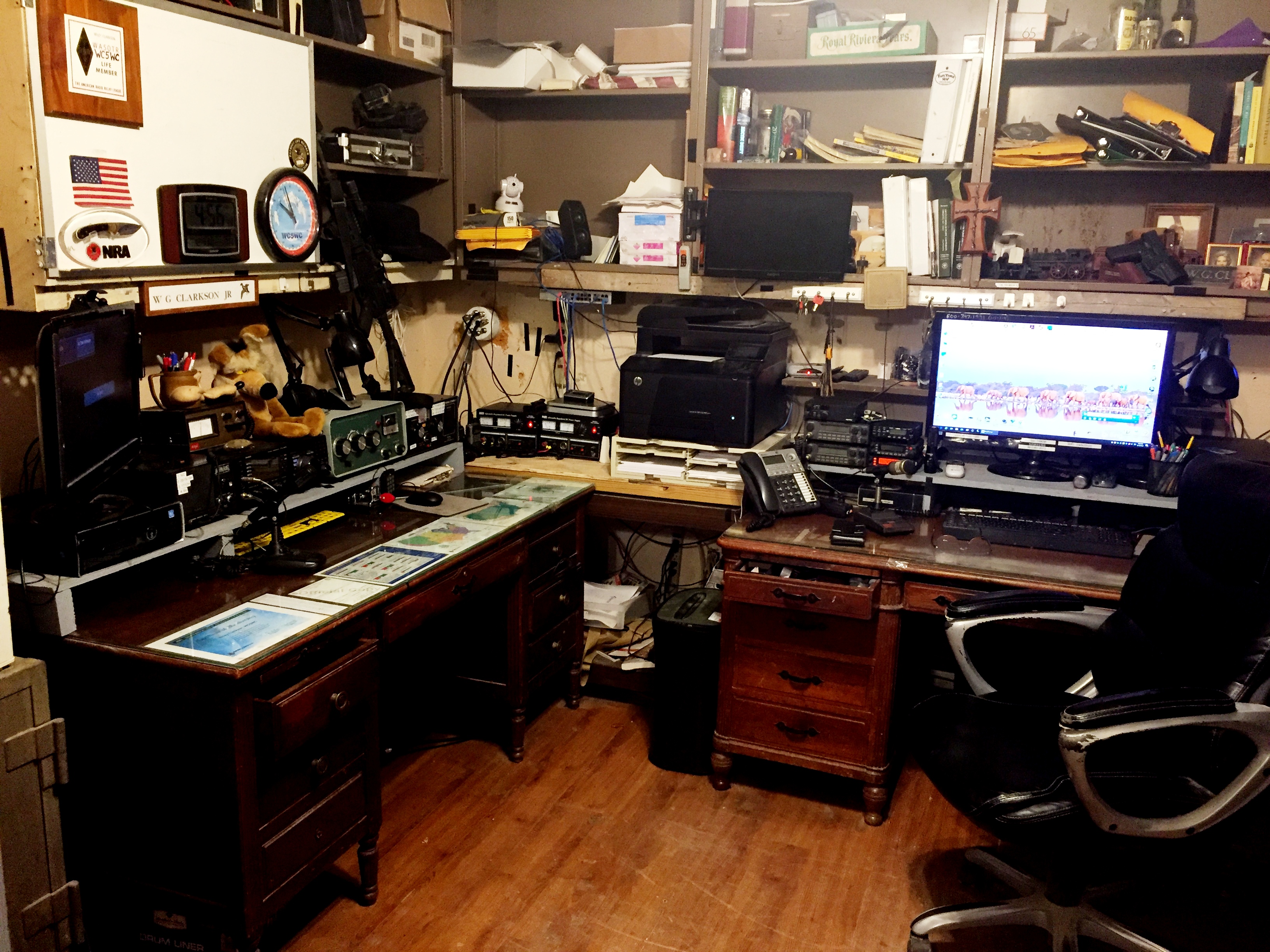
My present radio station consists of several transceivers. The main radio is my Yaesu FTdx-3000, for 160 thru 6 meters SSB. A Heathkit SB-200 amplifier is used mainly on 20 and 40 meters for about 800 watts output and an MFJ-989D tuner. My 29, 50, 146, and 442 FM operating poisition on my second desk consistes of an Anytone 5888UV, a Ranger RCI-5054dx and a Uniden Pro510XL for local CBers. I also have a UHF backyard repeater repeater on 442.575 plus 5MHz 88.5PL. I use GMRS, call sign WQWR 851, on 462.550 79.7PL for family communications with grandkids on my property.
Not shown in the station photo is a repair and projects bench located 8 feet away directly across from the operating position and a computer and office desk to the right of the operating position forming a spaced out U shaped desk area. This desk is used for office work and web site design, Ebay, etc.
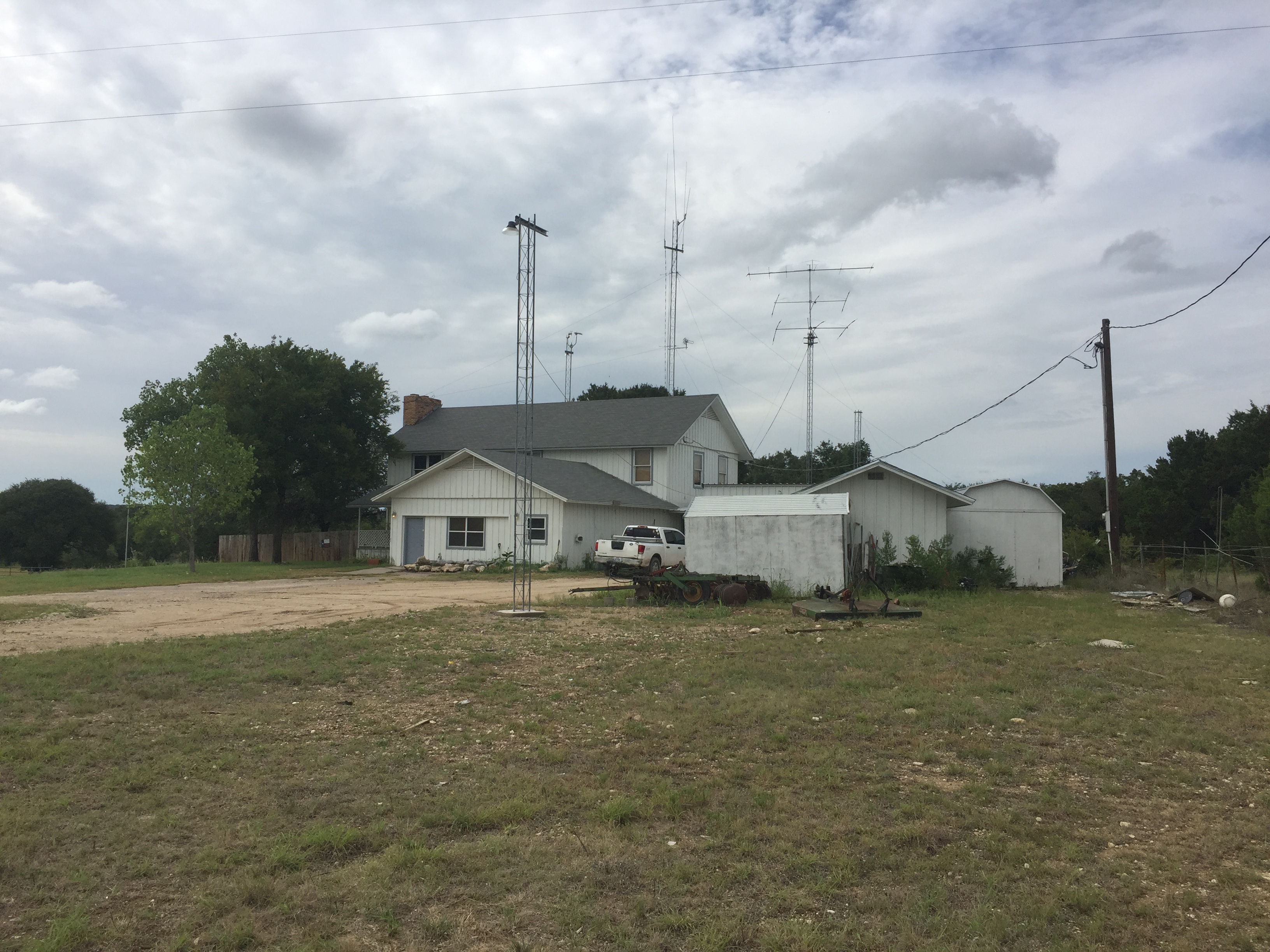
My antennas for HF are as follows: 160/75 meter inverted V fan doublet at 45ft on my 45 ft HF tower. A second Fan doublet will be installed in the Fall for 60 meters and 30 meters. On my 45 ft. tower I have a Cushcraft A3s for 20/15/10m at 52ft, an A3wb for 17/12m 57ft, and Cushcraft DB40 dipole at 62ft. I have two 144/440 verticals/ 460 verticals on my 65ft tower. My other 45ft tower has Cushcraft yagis for 146 and 440 and a HyGain 66b 6element 6m yagi.
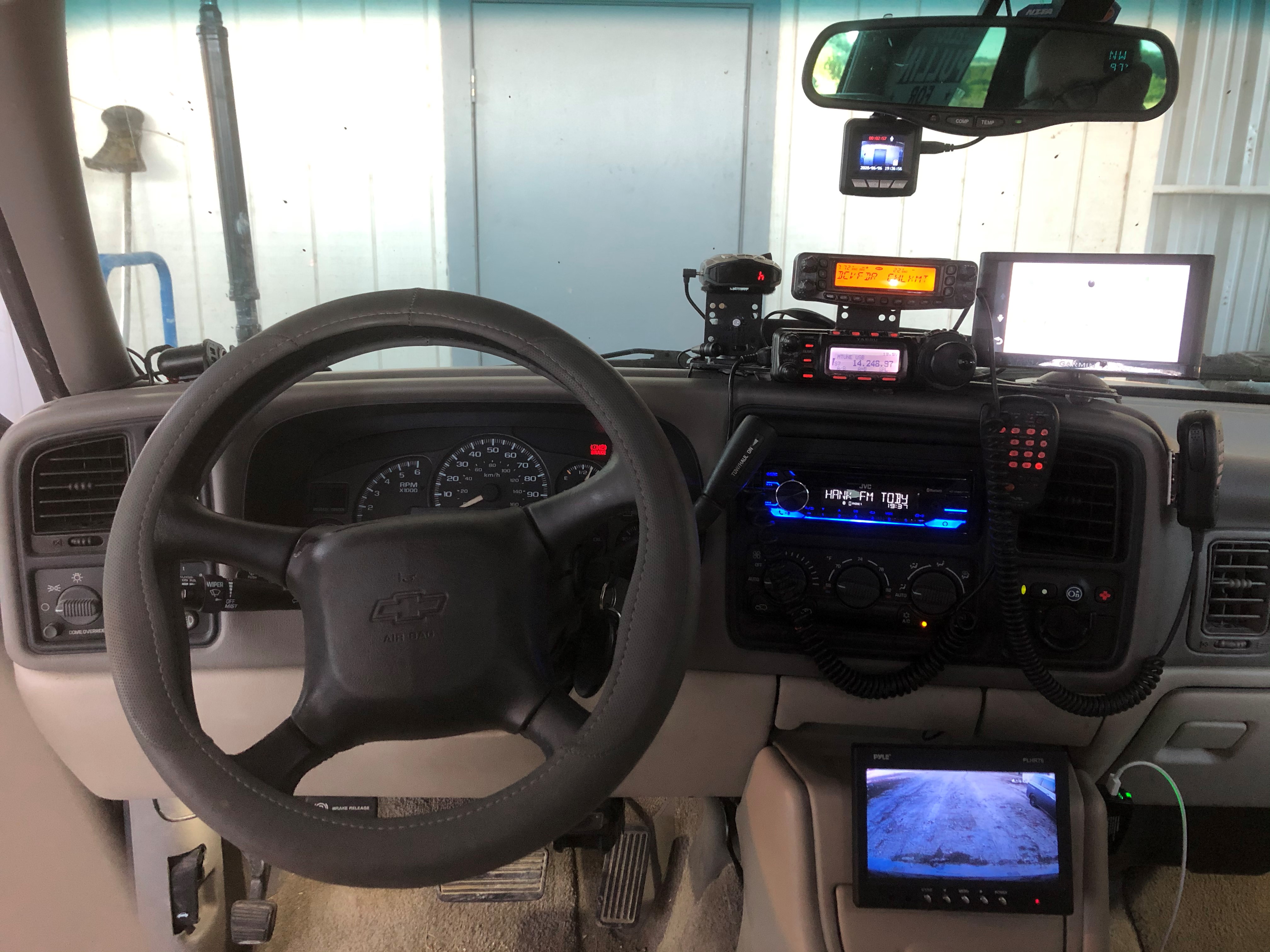
My 2002 Suburban 1500LT 4x4:
My every day vehicle is 2002 Chevy Suburban and a 2011 Nissan Quest as a second vehicle. I am now running a Yaesu FT-857d tied to a Yaesu ATAS-120a mobile antenna for HF and an MFJ dual band antenna for 144/436 SSB/FM. I have a 2nd radio for FM only, Yaesu FT-8900r with an Diamond tri band whip for 6/2/70cm FM. Yaesu, in my opinion, has the best mobile radios on the market for the money. I developed several mods for the ATAS that helped it survive for 14 years. They are on this web site, along with mods for the FT7900r that I figured out.
50 Years of ham radio happenings in my life
A collection of scans of different photos, QSLs, Certificates earned, recognition, etc
A look at some of the different radios I have owned over the years. There are many more that are not shown!
A few of my Radio related projects
My Comet, Diamond, and MFJ VHF/UHF antenna spring projects (pdf)
Yaesu FT-7900r extended transmit modification
Cheap Coax Cable Supports for running coax up a Rohn 25 Tower.
45Ft tower with an antenna elevator (similar to a Hazer)
Vertex-Standard MD-12A8J to Anytone AT-5888UV conversion
My home office/ham shack history for the last 13 years
July 7, 2007:
After using one radio for quite a few years, during extremely severe weather that came through while I was at work, my house sustained a direct hit from lightening which did more than $12,000 damage to electronics, appliances, and A/C. I no longer have a fixed station as everything was fried and the antennas were literally blown apart by the sustained lightening strike. The insurance company, Germania, did everything they could to take the maximum depreciation they could get before paying any money. As a result, after repairing the house, computers, and telephones, there was just enough money left to purchase the Yaesu VX-7r that now serves as my handheld. My Kenwood TS-690s, ADI AR 146 and AR 447, along with power supplies, antennas, antenna tuners, numerous computer peripherals, all network wiring, phone wiring, coaxial cable, high quality amplified stereo speakers, Teak stereo, and our best TV could not be replaced. A word of warning to anyone reading this page: check the fine print of your Home Owner's Insurance. If it says replacement costs, change policies or change companies to get a policy that says "cash value"!
I wasn't told this is what I should have until after the damage was done.
October 28, 2008
I am getting close to completing the rebuilding of my station after the destruction caused by the lightening strike. I have always been a techno nut and I love new techno gadgets. However, this time I decided to build what might be called an antique station by today's standards. I decided to get on Ebay and eventually build as complete a Drake 4C line as I could. When I was first licensed, I had always had this desire to own Drake. Back in the 1960's and early 1970's, however, I never had the money. I learned alot about buying old equipment off Ebay in the last year. I now have the basic 4C line but it did cost some money. The worst side of purchasing equipment off of Ebay is that you are at the mercy of the seller. The equipment I ended up with had issues, even though the sellers "said" it appeared to be in good shape. After a year of trying, I put together the basic station. It was then that I decided to look for someone who was skilled in restoration of old equipment as I soon learned that this was beyond my present skill level. I soon found Jeff Covelli, WA8SAJ. I sent both the R-4C and T-4XC along with all the cables to him. He stripped down the radios, cleaned and repaired mechanically problems then after reassembly he completely retuned the transmitter and receiver fixing many more issues than I had realized were present. When he returned them to me, it took exactly one day to get everything put back together and hooked up. Every report I have received has been "great audio and strong signal!" It's fun using the older equipment from the 70's at he house. It has a "feel" that is just not in the new equipment manufactured these days.
November, 2009
Every once in a while, I get lucky! I was reporting to work when a plant employee met me as I was getting out of my truck and asked if I was ham operator. He said he had a radio his father had used and it was just stored in a closet and was I interested in it. Of course I said I was interested in any amateur radio equipment if the price was right. He then told me he would bring it to work and I could take it home and check it out. It turned out to be a Kenwood TS-520s transceiver that looked and operated like it had just come out of the factory box fresh from the factory! The price turned out to be "right" and it now sits on one desk in my shack, with my Drake station on the other desk. I have since added some Kenwood accessories and hooked it to a full size 1.9MHz inverted V and a full 1/4 wave ground plane. Both antennas are mounted at 70 ft above the ground. Over a period of a few months, I was able to purchase all the accessories for the Kenwood TS-520S system.
December 2010
When the grandfather of a fellow employee of the company I worked for became a silent key, the family asked if I would help them evaluate and sell the station. Included in the station equipment was a Yaesu FT-1000D that had been hit by EMP from lightning. Before it was over, I ended up purchasing a large amount of the station, which included all the EMP damaged equipment. For 146/442 MHz FM I am using an old Alinco DR-600 with a vertical at about 65ft. HF antennas include several wire antennas at 70 ft., a 1/4 vertical at 65 ft, a Hustler 5BTV at ground level, a full size 160 meter inverted V, a Workman vertical for 28 MHz and CB, and a Jetstream JTV-680 all band vertical. I hope to add yagi's for 20-15-10 meters and 6 meters this summer.
2011
I retired Feb. 24, 2011, after 27.5 years, as a Central Alarm Station operator specializing in daily security operations communications and contingency response communications. I also did duties as an armed security officer at a nuclear power plant. Sold off all of my Drake and Kenwood radio equipment preparing for retirement.
2012
Still don't have much time for ham radio, but see the light at the end of the tunnel! Purchased six and two meter yagis in late 2011. A 45 ft tower for beams is in the process of being installed for the VHF yagis and a future HF yagi. Nothing has changed with the station. All antennas on my 65 ft tower and 40 ft tower have been repaired and I think I am ready for the cold dark months of winter when I tend to want to hibernate! Everything is working good. Now own two Wouxon KG-UV6D's for my Amateur Radio, GMRS, and VFD communications needs. Great little hand held radios!
2113
This has been a continuation of 2012. The 40 ft tower is now nearing final installation. I am building an "antenna elevator platform" using the top three ft of an old Rohn 25 top section. When I finish it, I will not have to climb the tower to work on my antennas. I plan to publish the details of this on my web site when it is completed. I finally was able to purchase the Yaesu FT-650 I had been looking trying to find for the last year. This radio was a low production radio and are rare on the auctions. They used the same receiver design as the FT1000d. It covers 24-54 MHz, ssb, cw, fm, am, etc at 80 watts output. I will probably try to purchase a FT-8800 or FT 8900 next year to replace my aging Alinco. Also purchased an Anytone VHF/UHF mobile transceiver. For the money, it is a very good radio.
2014
completed installation of the 45 ft tower with the elevator and mounted a 14 element yagi for 146 MHz. Purchased am FT-650 Yaesu transceiver for 50 MHz and my 6 element yagi that is still un-assembled. Also assembled two UHF repeaters for very few dollars! I love Ebay!!! Both repeaters are on the air with an antenna height of 60ft. Also began various small antenna and electronics projects.
2015
It is Jan 5, 2015 so the year is just starting! Passed the Extra exam on first try. I used QRZ.com practice tests (apx 70 tests) to learn the required information to take the test. My backyard repeater for hams in Walnut Springs is 442.575 MHz pl88.5. The antenna, a 17ft MFJ dual band vertical, is on my 70ft tower. Coverage is presently limited to the Walnut Springs part of Bosque County. Plans are to link the repeater to the Hood County 442.025 repeater sometime in 2016 when funds become available. I also have the 462.550 MHz repeater on the air on a very limited basis. I'm still looking for a higher location for my 442.575 repeater. August 09, 2015, I finished installation of a used Cushcraft A-3 triband beam, Hy-Gain 66b Six Meter yagi, Hy-gain 14 element 144.000Mhz yagi, and a Cushcraft 10 element 440 MHz yagi on a 45 ft Rohn tower.
2016
January: I added a Chinese TYT TH9800. It has a Diamond 146/440 at 70 ft and a Jetstream Jtv680 for 29 and 52 MHz at 45ft. Changed out my old desktop PC for a Netbook 10.7 on my larger monitor. Works nicely for logging!
March: added another wall feed-tru for more coax lines. There are now eleven coax lines with room for 5 more. Also located an unused 30ft tower for the takedown sometime in April. If it is a Rohn 25, my 70ft tower will become 100ft! Added Cushcraft A3wb above my A3s.
2017
Sold my FT1000d and FT650 and purchased a Yaesu FTdx-3000. Also purchased an FT-8900r for my Quest.
2018
Added a Heathkit SB200 and MFJ-989D.
2019 and 2020:
I have enjoyed operating when I could not do other things. Surgeries on both wrists and shoulders and the Covid-19 restrictions restricted many ting I had planned during the last two years. I am behind on antenna repairs and improvements. I upgraded my station to be able to get on Digital but it is only a last resort mode as I use normally use voice. I still keep Morse keys on my HF radio and every once in a great while I will do a little copying of Morse just to keep from loosing my ability althogether! I purchased a 2002 4x4 Suburban 1500 LT for a travel vehicle that had only 94,000 actual miles on it. It is now the main vehicle and my Quest is a backup vehicle. Most of our traveling was stopped by the Chinese Covid Crisis. We are gold members of Wyndham Resorts. It is expensive but it is by far our favorite way to travel the USA looking for ancestry records and history. We are fixing up the old Roo hybrid camper for some future camping now that I have a vehicle to pull it. I have had numerous radio projects but my collection of radios that do not work is growing due to my eye sight and hand shake keep me from working on the surface mount parts on modern circuit boards. I blew the power supply in my old SB200 and did the Harbock upgrades. I high recommend the Harbock P/S mods and a new set of tubes from DX-Engineering. My SB200 is now putting out 800 watts instead of 500-600 watts before the mods and tubes.
Links to several Amateur Radio Pages
ARRL.org The American Radio Relay League: The National organization that represents Amateur Radio Operators. A very good source of study materials, information, up-to-date happenings, publishers of QST, the official journal for the ARRL that is published monthly. They also sponsor operating events like Field Day and the ARRL International DX Phone Contest, to name just a couple.
QRZ.COM This site is loaded with useful information and links and online study for Amateur Radio exams.
TX VHF FM SOCIETY If you are going to be are or are going primarily a VHF/UHF operator, you need to support this organization.
National Skywarn Homepage The National home site for SKYWARN
NOA Ft Worth-Dallas Skywarn This is an important source of information for North Central Texas
WEATHER CHANNEL RADAR This is my preferred radar for storm chasing. It is also available in an iPhone app.
This page updated on 11/16/2014 by Wiley Clarkson WC5WC